
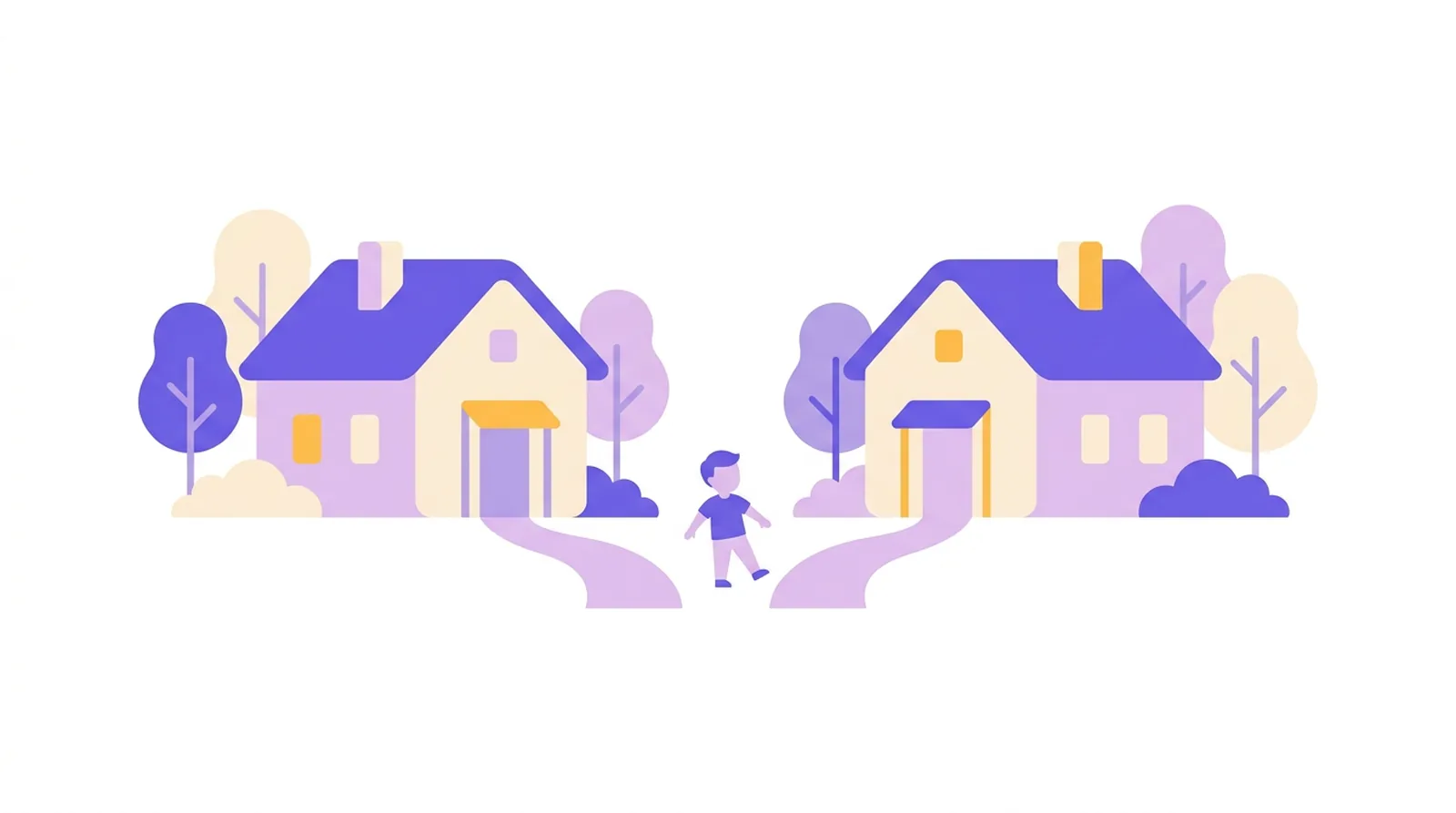
Two homes, one child, one system in each
Reward Study lets one Apple Account own two entirely separate households, each with its own kids, tasks, rewards and ledger. Nothing crosses between them. From Reward Study 2.0 two households are included with Pro; earlier versions charge a one-time add-on instead, and nobody ever gets a third household on the same account.
households the same Apple Account can own
the old one-time add-on price, retired for new sales in 2.0
records that cross between the two households
The problem
Why do separated parents need two entirely separate systems?
When parents share custody, one household is not one truth. A rule set in one home does not travel to the other, a reward earned during one week is meant to be spent while the child is somewhere else entirely, and folding both parents' data into a single shared record either forces an agreement neither parent wants to make, or asks for a level of coordination that a difficult week does not have room for.
That is a different situation from two parents raising the same children together under one roof, which two parents, one ledger already covers, and from the shared arrangement described on the co-parents page. Two households solves the case where the two parents are not running one home at all, and where sharing a ledger would mean sharing decisions that belong to each home separately.
It is also not a case either parent wants to solve with two separate Apple Accounts, two separate subscriptions and two separate installs that happen to run the same app. One person, one Apple Account, and two households under it is a much smaller thing to manage than two of everything.
The child's side
Does a child have to explain themselves twice?
A child moving between two homes already manages two sets of expectations without any help from an app. Two separate households means the chores and rewards that belong to one home stay there: a reward saved for at their mother's house is not something to justify or re-earn at their father's, and a rule that applies in one home does not quietly apply in the other because a shared system decided they should match.
It also means a bad week at one house does not show up as a number on a screen at the other. A frozen or lapsed household only affects the household it happened in, and a child's balance in one home is not something the other parent can see or comment on unless they are actually told about it directly, the way people told each other things before there was an app in the middle of it.
Praise works the same way. A one-tap praise chip attached to an approval, one of five fixed, gender-neutral phrases the app offers on every approval, is something a child sees from the parent who is actually there that day. It is not a shared feed either parent can add to from wherever they happen to be, which matters more in a two-household arrangement than in almost any other setup the app supports.
What changed in 2.0
What does a second household actually cost now?
From Reward Study 2.0 (September 2026) two households are included in Pro. Earlier versions sell a Second Household add-on for $4.99 once, and anyone who bought it keeps it.
In practical terms: a family already on 1.x who paid the $4.99 add-on does not pay again and does not lose anything moving to 2.0. A family starting fresh on 2.0 gets the second household as part of the same Pro plan they already pay for, with nothing extra to buy. See pricing for the current plans and what each one includes, including the yearly, monthly, weekly and lifetime options a household can choose between.
One number stays fixed across both versions: nobody gets a third household on one Apple Account. Two is the ceiling, not a starting tier that grows with a bigger plan. And joining a household by invitation, the ordinary co-parent case, never needs a second household and never takes a seat, in either version, because that is a different feature solving a different problem.
The pricing model change also reflects a wider shift in 2.0: Pro stopped being sold as unlimited kids, tasks and rewards, and started being sold as what actually stays available if a subscription lapses. A second household sits on the same side of that line as everything else Pro includes now, rather than as a separate purchase bolted on for a specific family situation.
The mechanism
What does nothing crossing between them mean in practice?
Each household is a complete, separate copy of the whole app's data model, not a filtered view of one shared pool. One Apple Account can hold two of these at once, and each one behaves as if it were the only household that Apple Account had ever created.
- Kids belong to one household, never both.
- Tasks and rewards are priced and set up separately in each.
- Credit balances and the full ledger are independent, so a balance in one home tells you nothing about the other.
- Approvals and history stay inside the household where they happened.
Built this way, a second household is not a shared calendar with two logins on it. It is a second, private instance of the same system, owned by the same Apple Account, with no wire between the two.
Setting one up does not skip any of the steps the first one went through either. The same five-step guided setup, child, tasks, rewards, parent PIN, finish, runs again for the second household, pre-filled from whichever problems get picked for that home specifically. A working second household exists inside its first minute, the same as the first one did.
Even the CSV export respects the boundary: the full ledger exports as a single file scoped to one household at a time, so there is no version of the export that quietly merges both homes' records into one spreadsheet by accident.
Two homes. Two households. Nothing shared unless you choose to share it.

iPhone, iPad and Apple TV. Requires iOS 17 or later.
Free for 14 days, then $39.99 a year.