For iPhone, iPad and Apple TV
The nagging stops when the deal is written down.
Your child sees what they owe, marks it done, and waits for you to approve. Nothing counts until you say it does, and every credit that moves has a reason written next to it. No more arguing about what was agreed.

Free for 14 days, then $39.99 a year. Cancel before it ends and you are never charged.
- No account and no login
- No ads
- No tracking and no analytics
- Data stays in your family's iCloud
Published studies behind it
Task templates, sorted by age
Badges, paced in months
Prompts sent to a server
What changes at home
From arguing about it to reading it.
Before · “I already did it”
Nothing counts until you approve it
The task waits in a queue until you look at it. Sending it back costs nothing.
Before · “That is not what we said”
Every task carries a price
Pick from the catalog or write your own, and say what each one is worth in credits.
Before · “Where did my credits go”
Every credit carries the reason it moved
Your child can read the whole history, so a balance is never a matter of memory.
The loop
Four steps, and then it repeats.
You set the tasks
Pick from the catalog or write your own, and say what each one is worth in credits.
Your child marks them done
On their own device or on yours, in a mode that shows only their side of the app.
You approve
The task waits in a queue until you look at it. Sending it back costs nothing.
The credits land
The balance moves, and the reason it moved is written beside it in the ledger.
Seven steps, on the screens you will actually see.
For parents
Set it up in one evening, then it runs itself.
Approvals queue
One list of everything waiting
The child, the task and the credits at stake. Approve one at a time, or approve them all.
Templates
Sorted by age from 6 up to 15 and over, and by kind: reading, writing, STEM, chores. Added with one tap.
Bonuses and deductions
Credits move for a stated reason
Add some for something you noticed, or take some off. The child reads the reason you typed.
Parent lock
Face ID, Touch ID or a PIN
Leaving the child's mode, exporting the ledger and deleting a household all ask first.
Praise
An approval can say more than a number
Pick a word as you approve it, and your child reads it in their own language beside the credits.
Progress
The days they turned up, week by week
Each child has a card counting the days with work approved, against the estimate you gave when you set the family up.
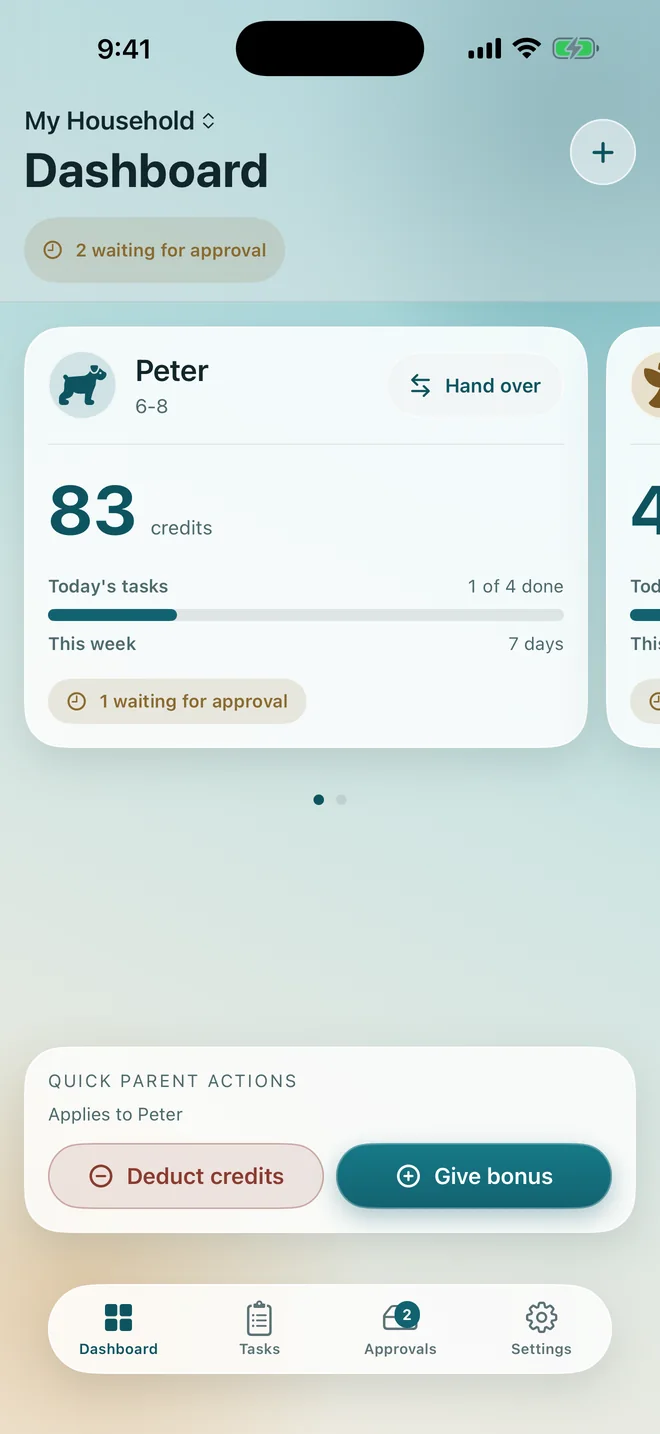
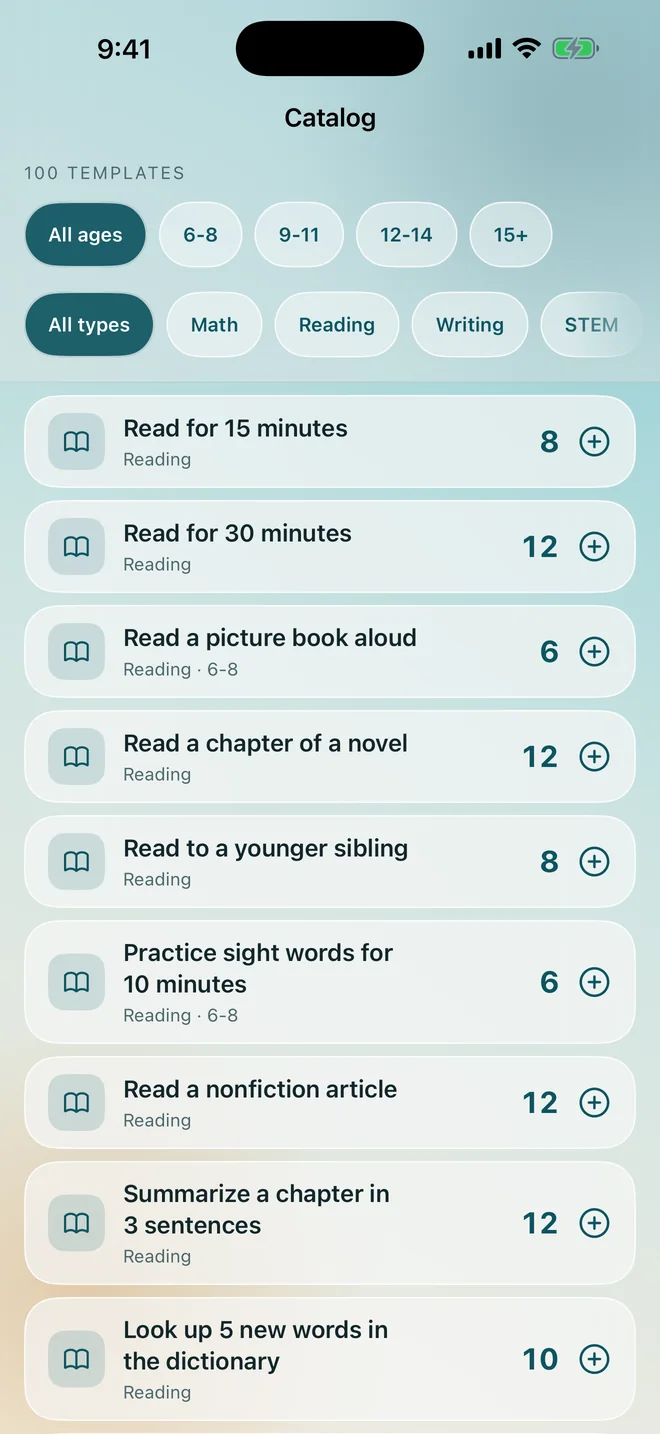
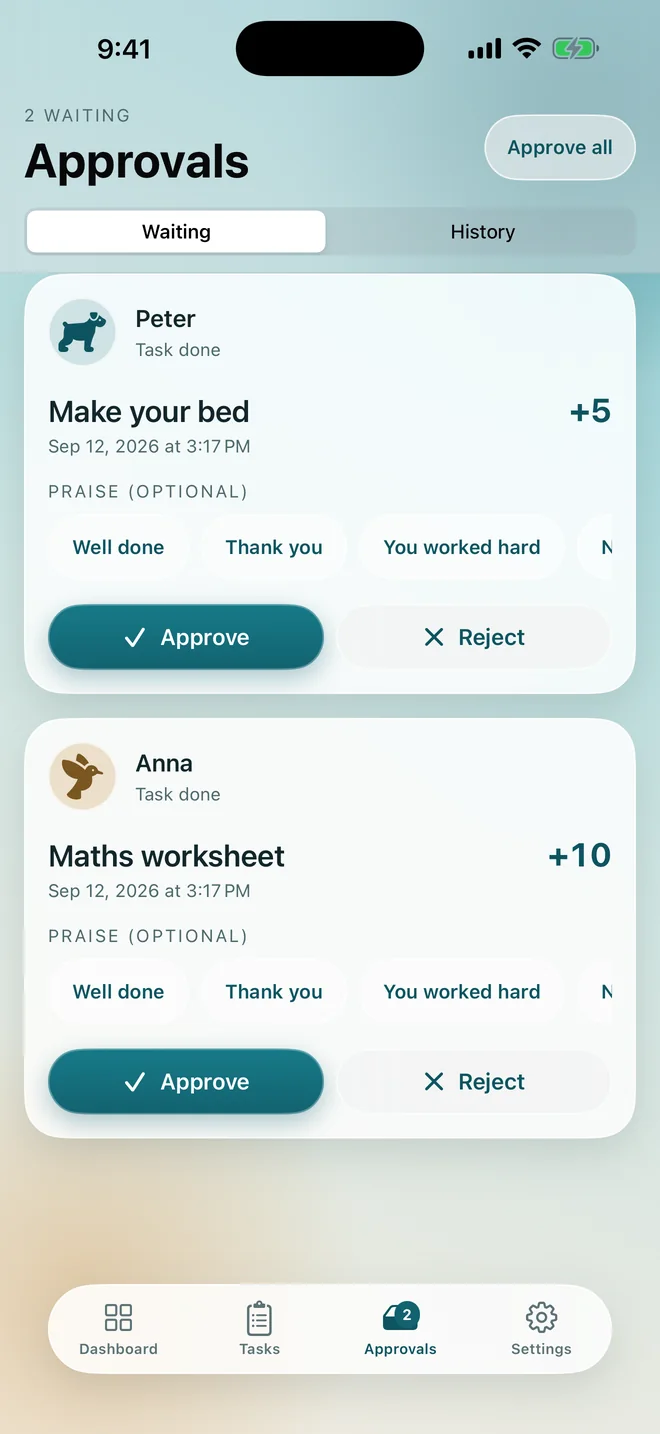
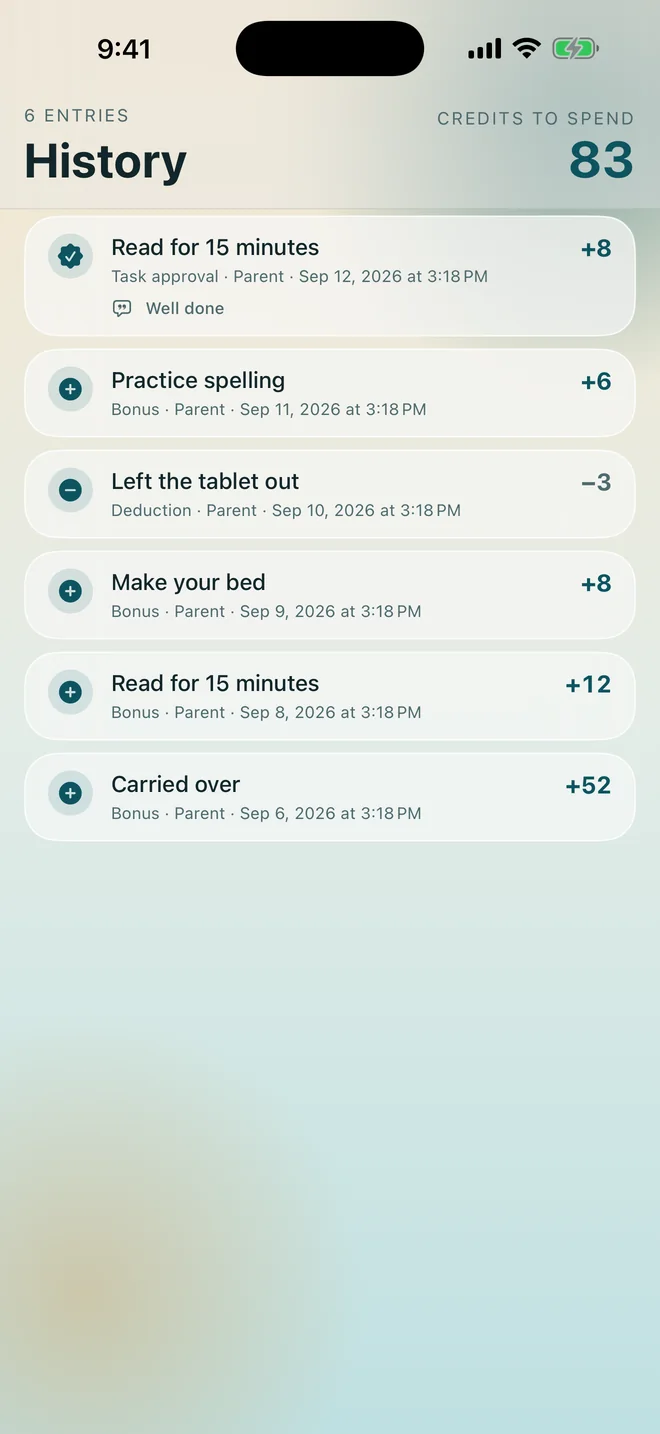
Four of the parent screens, shown from the top down. The app is built for a phone held in one hand while the other hand is busy.
For kids
Their side of the app looks like a treat, and it is meant to.
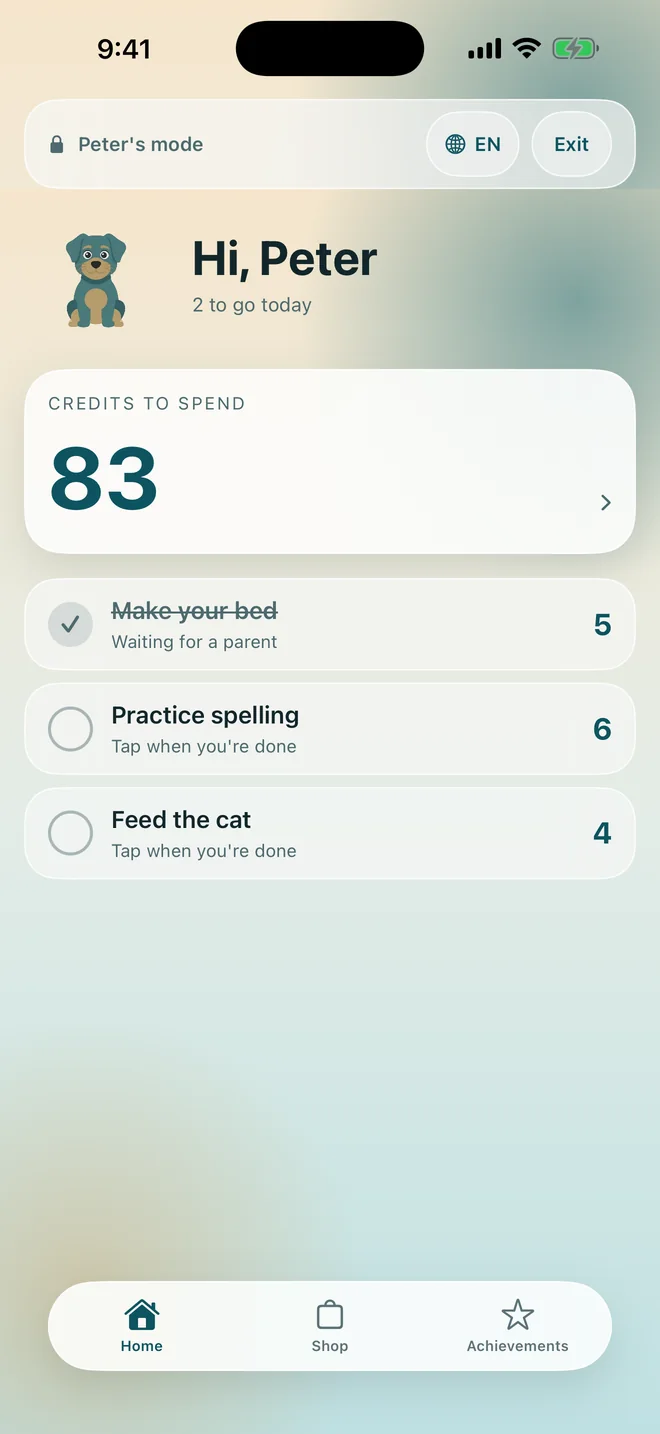
The child's mode shows what is left today, what a reward costs and how close they are to it. Streaks count the days. Levels count the tasks. Badges are built to take months, not minutes.
Badges
Tracks
Tiers each
The child cannot approve their own work, change what a task is worth or edit the ledger. They can only mark a task done and ask for a reward.
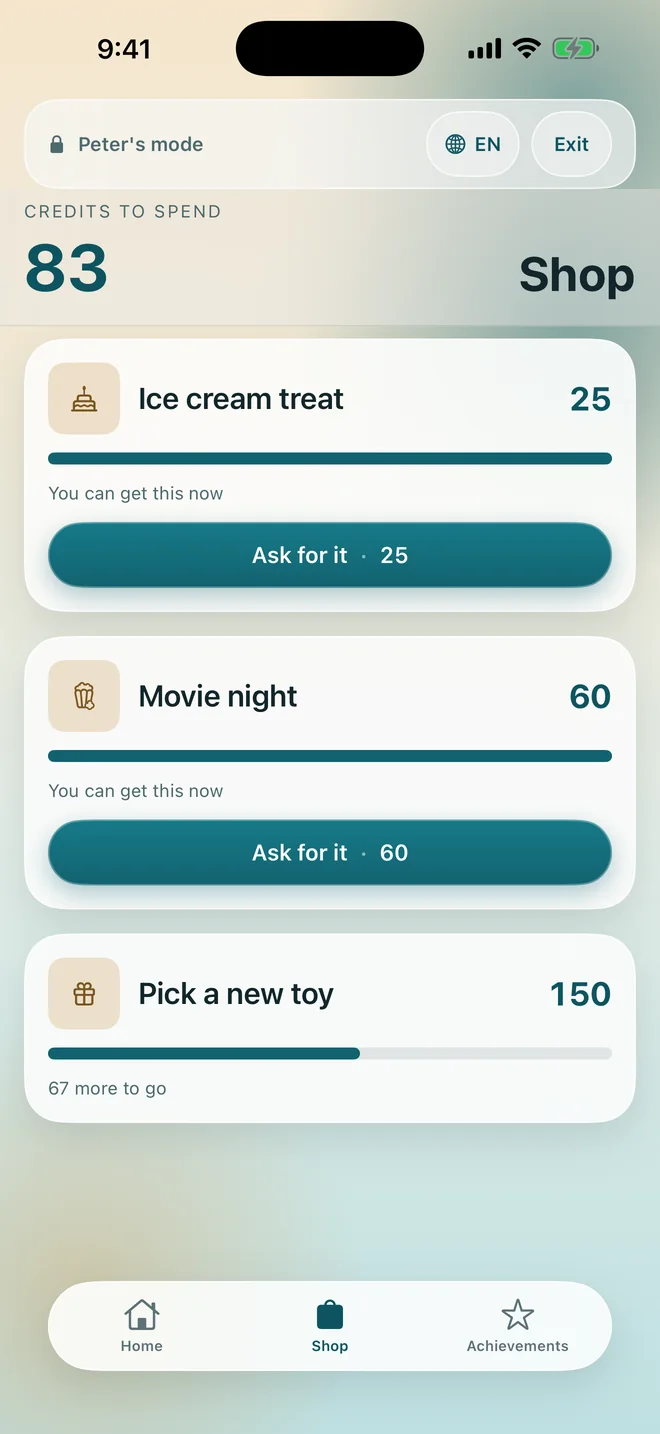
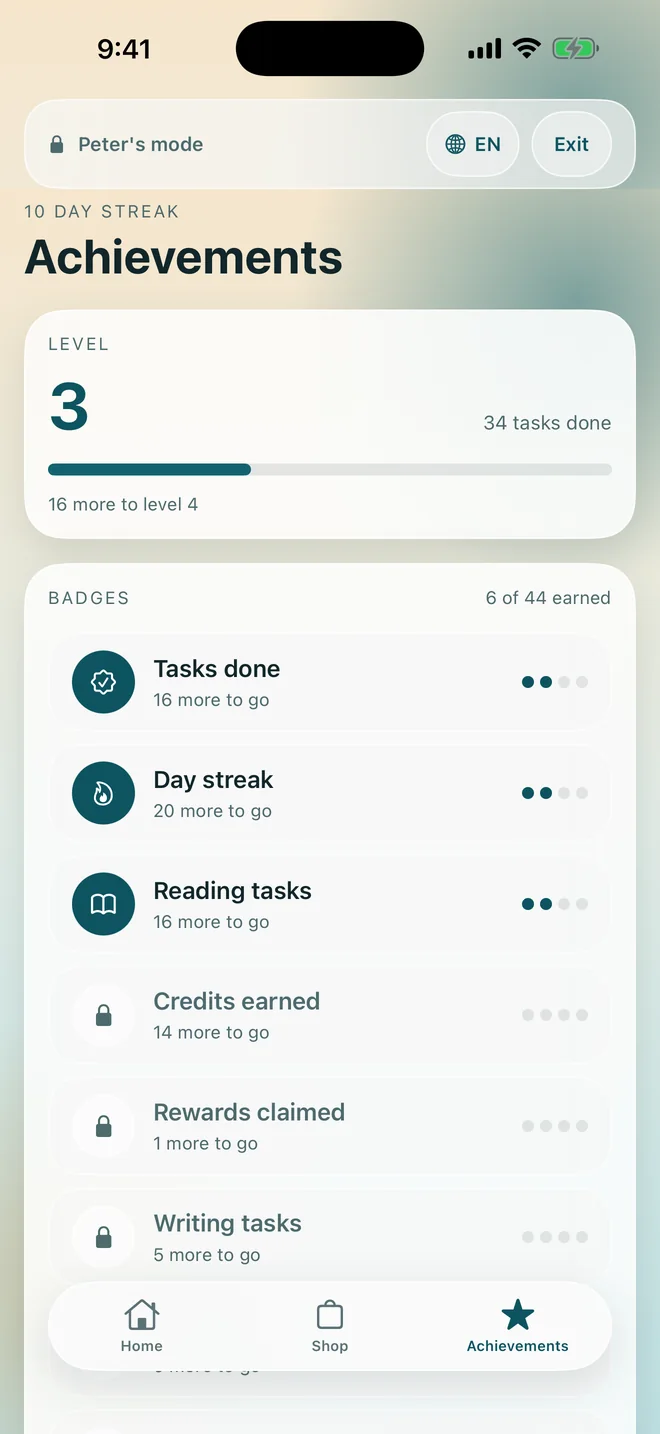
Expert opinions
What the research actually found.
Chore charts, tokens and praise have been studied for decades. These are the findings the app is built on, each with the paper it came from. The same screen is inside the app, before anyone is asked to pay, and every study is linked from it.
Praise
154 trials of parenting programmes
Across 154 trials of parenting programmes, praise and positive reinforcement were among the three techniques linked to stronger results.
Leijten et al., 2019, Journal of the American Academy of Child & Adolescent Psychiatry
Token rewards
28 classroom studies
Earning tokens for good behaviour had a strong effect across 28 classroom studies, and worked a little better for ages 6 to 15.
Soares, Harrison, Vannest & McClelland, 2016, School Psychology Review
Chores
9,971 children, followed to third grade
In a study of 9,971 children, those who did chores in kindergarten reported more confidence, better friendships and more satisfaction with life in third grade.
White, DeBoer & Scharf, 2019, Journal of Developmental & Behavioral Pediatrics
What you praise
The effort, not the child
Toddlers whose parents praised their effort, rather than the child, showed a stronger growth mindset five years later.
Gunderson et al., 2013, Child Development
The limit of rewards
Why an approval can carry a word
Rewards can dull a child's interest in things they already love, but praise raises it. That is why every approval here can carry a word of praise.
Deci, Koestner & Ryan, 1999, Psychological Bulletin
Habit
In two diary studies, 35% and 43% of what students did each day was habit: done almost every day, usually in the same place. Good habits make the difference. Which ones your child builds is still up to you.
Wood, Quinn & Kashy, 2002, Journal of Personality and Social Psychology
These studies looked at the approach, not at this app.
Apple Intelligence
Maths practice that writes its own word problems.
The word problems are written on the device by Apple Intelligence, so a plain subtraction becomes a question about trains or animals. The numbers and the answers stay exactly as generated, and you read the whole set before your child sees any of it.
Practice runs from addition and subtraction up to percentages, and it earns credits like any other task.
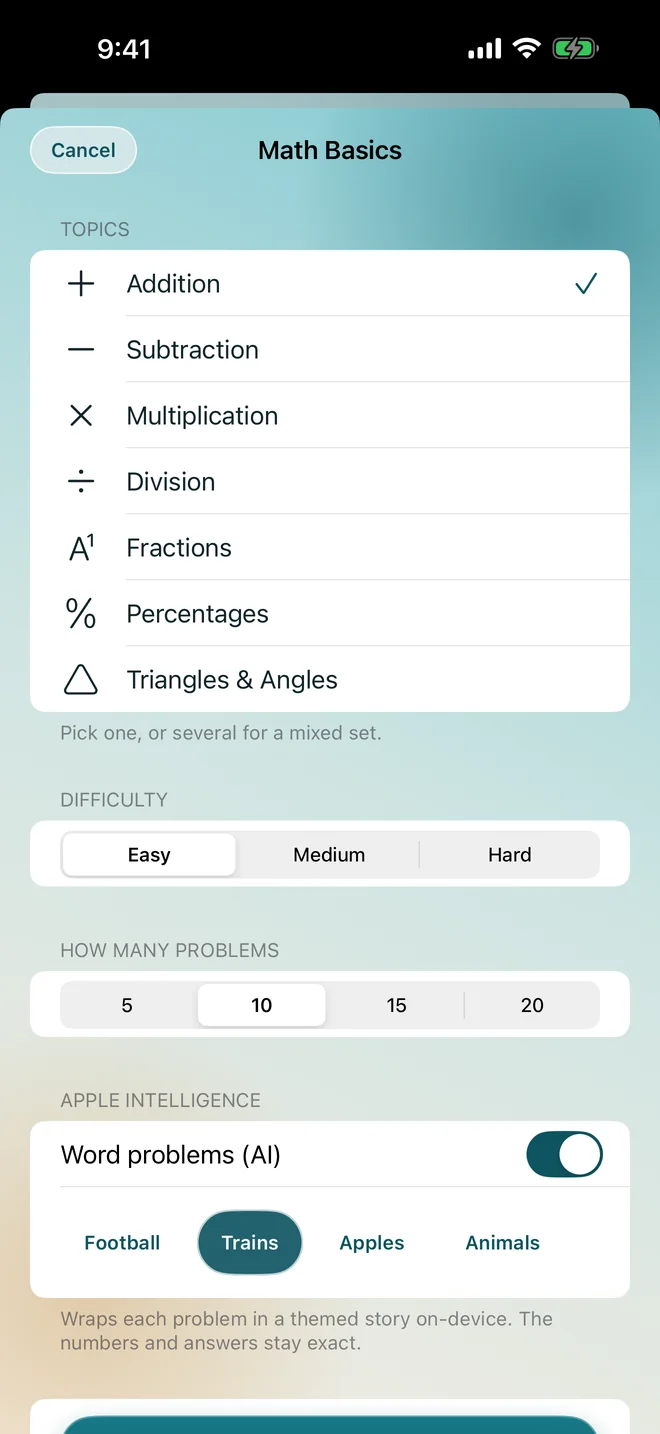
Word problems need a device that supports Apple Intelligence. The rest of the maths practice works everywhere.
On Apple TV
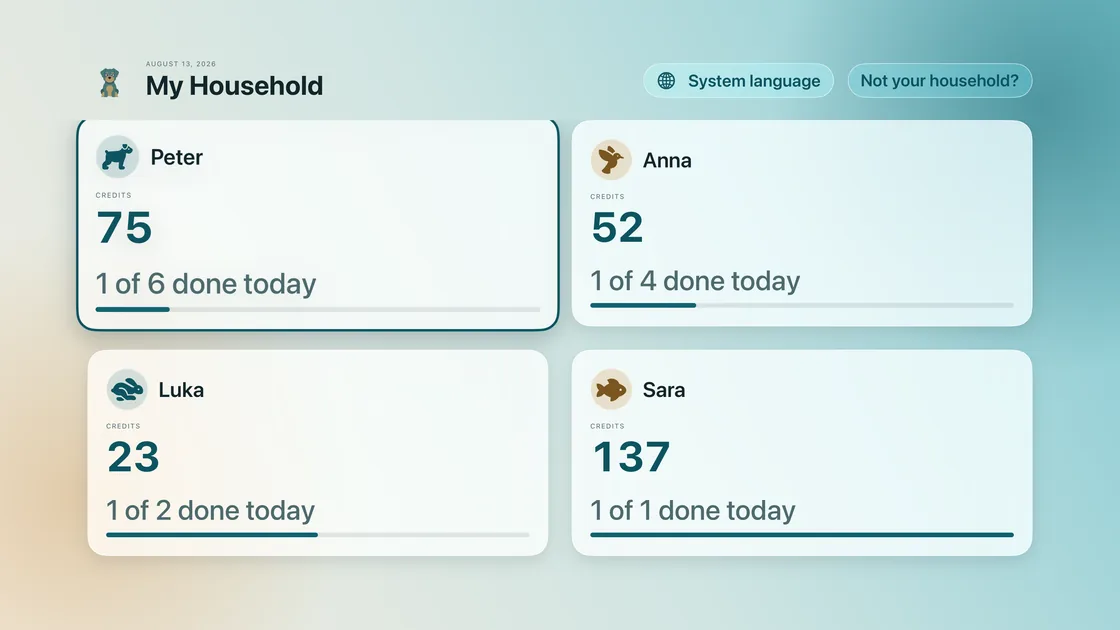
A scoreboard the whole room can see.
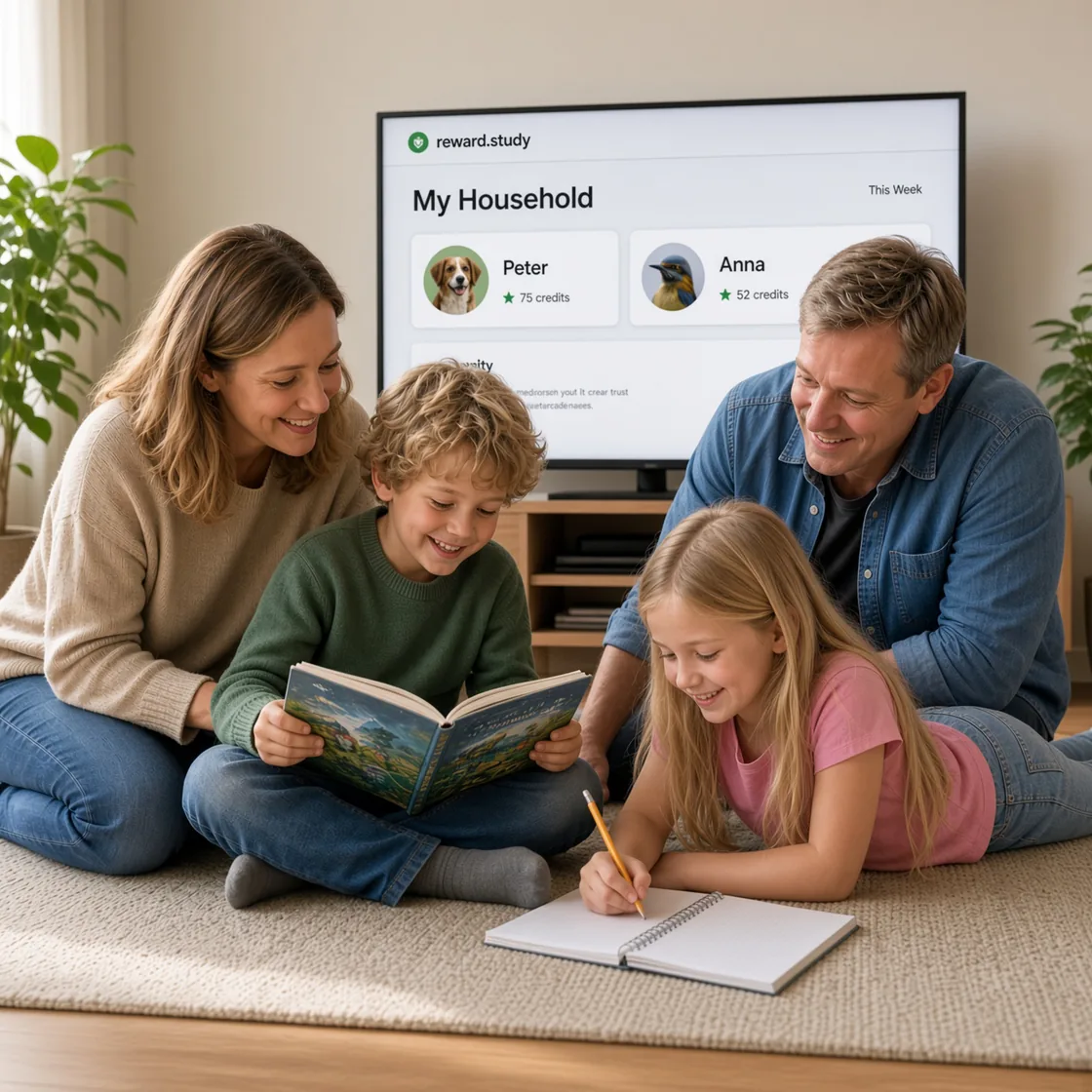
Balances and today's progress for every child in the household, on the television.
It is read only by design. The Apple TV app cannot approve anything, because a remote in a child's hand must not approve its owner's chores.
Two homes
2 homes, 1 child, 1 system that works in both.
Each home keeps its own tasks, its own rewards and its own balance, and neither parent can see or change what happens in the other one. No shared Apple family required.
Privacy and price
No accounts, and nothing hidden in the price.
Reward Study Pro, yearly
Unlimited children, tasks and rewards, the AI word problems and the CSV export, shared with your Family Sharing group. The first 14 days are free, and the trial turns into the paid year unless you cancel it before it ends.
Or $2.99 a week, with no trial. Both plans renew until you cancel them in your App Store subscription settings, and you keep access to the end of the period you paid for. The App Store shows the price in your own currency.
Or pay once. Reward Study Pro, lifetime, is $99.99, bought once and never renewed, with Second Household and Reward Ideas included, and every future update.
What the app does not do
- No account and no login
- No ads
- No tracking and no analytics
Data lives in your family's own iCloud, not on a server we run. Apart from the visit counter you can decline, this site requests nothing from any other domain.
Two add ons are bought once and never renew. Second Household, $4.99, lets your Apple Account own a second household of its own. Joining a household by invitation never needs it. Reward Ideas, $1.99, adds fifty ready-made reward ideas with suggested prices.
Before you start
Answers, shortest first.
Where does our data live
In your family's own iCloud. There is no account to create and no server of mine holding anything, which is why the App Store listing reads Data Not Collected.
Can my child use their own device
Yes. Install the app there, join the same household through iCloud sharing, and put that device into the child's mode. It stays in that mode until a parent unlocks it.
How does the other parent join
By invitation, free, from Settings. They get the same household on their own device. A child's device joins the same way.
How do I cancel the subscription
Open Settings, then Reward Study Pro, then Manage subscription, which opens Apple's own sheet. A free trial cancelled before its 14 days end is never charged.
Why can the Apple TV app not approve
It is read only on purpose. A remote in a child's hand must not approve its owner's chores, so the television shows balances and progress and nothing more. Approvals happen on a parent's iPhone or iPad.
How do I get the ledger out
Settings, then Export ledger, behind the parent lock. It writes a CSV file with one row per entry, including the reason, who did it and when.
Every answer is written by the person who builds the app, and there are more of them on the support page.
Missing something
Want a feature? Ask for it.
Reward Study is built by one person, and the next thing I build is usually the thing a parent asked for. Tell me what is missing and I will read it myself.
Write the deal down once, and stop repeating yourself.
Free for 14 days. No account, no ads, no tracking. Cancel before the trial ends and you are never charged.